Color can completely change the way a streetwear outfit looks.

The same hoodie can appear casual, bold, minimal, or sophisticated depending on the colors worn with it. A graphic T shirt can become the main focus of an outfit when paired with neutral bottoms, while the same shirt can create a completely different impression when combined with several strong colors.
The good thing about streetwear is that there are very few strict rules.
You can work with neutral shades, experiment with contrasting colors, build monochromatic outfits, or use one bright piece as the focal point. What matters most is understanding how different colors interact and knowing when to keep things simple.
Whether you prefer oversized hoodies, graphic T shirts, relaxed bottoms, or coordinated sets, learning a few basic color principles can make putting outfits together much easier.
Why Color Matters in Streetwear
Color is one of the first things people notice about an outfit.
Before someone looks closely at the fabric, stitching, or small design details, they usually see the overall color combination.
This makes color particularly important in streetwear because the style often relies on visually recognizable pieces.
A bright hoodie can immediately become the focal point.
A black outfit can create a minimal appearance.
Cream and brown can create a softer casual look.
Grey and navy can provide a more understated combination.
The right colors can make even a simple outfit feel intentional.
Start With One Main Color
A simple way to build a streetwear outfit is to choose one main color first.
This could be the color of your hoodie, T shirt, bottoms, or sneakers.
Once you have your main color, select supporting shades around it.
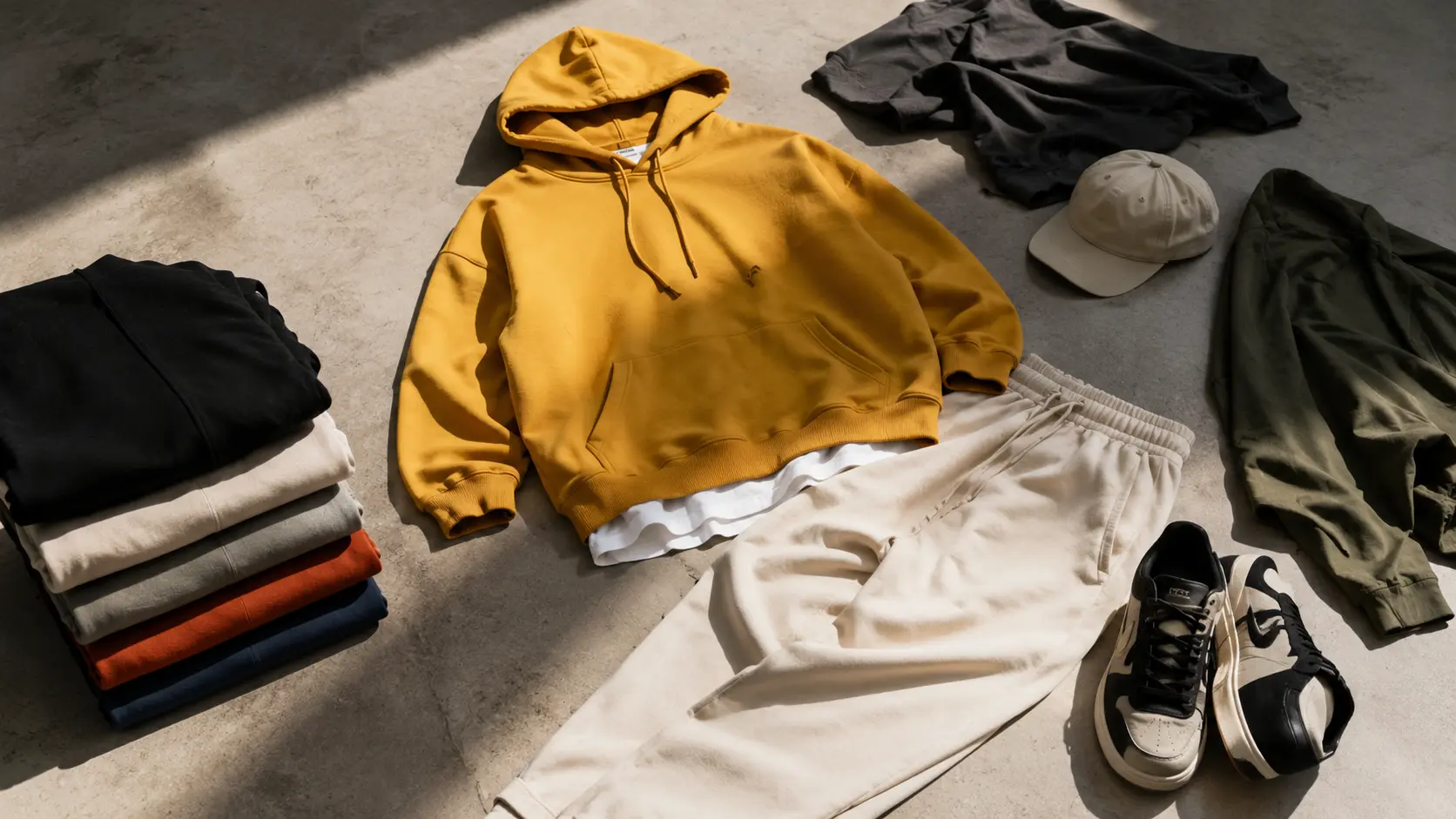
For example, if your main piece is a mustard hoodie, you could pair it with black, cream, brown, or dark denim.
If your main piece is a dusty blue T shirt, grey, white, cream, and navy can work as supporting colors.
Starting with one dominant color prevents the outfit from becoming unnecessarily complicated.
Use Neutrals as Your Foundation
Neutral colors are among the most useful shades in any wardrobe.
Black, white, cream, beige, grey, brown, and navy can work with a wide variety of other colors.
This makes them especially useful for streetwear.
A neutral hoodie can support a colorful graphic T shirt.
Black bottoms can balance a bright top.
Cream trousers can soften a darker outfit.
Grey sweatpants can work with almost any casual top.
The hoodie collection can be paired with neutral bottoms and sneakers to create a simple foundation for experimenting with color.
Why Neutrals Are So Versatile
Neutral clothing does not demand attention.
Instead, it creates space for another piece to stand out.
This is useful when you have a graphic T shirt or colorful hoodie that you want to make the center of the outfit.
Black Is the Easiest Supporting Color
Black is particularly useful because it can provide contrast without introducing another strong color.
A colorful hoodie with black bottoms is a classic combination.
A graphic T shirt with black trousers keeps attention on the artwork.
Black sneakers can connect different pieces without competing with them.
However, an outfit does not need black to look balanced.
Cream, grey, navy, and brown can provide similar versatility while creating a softer appearance.
White and Cream Create a Lighter Look
White and cream can make an outfit feel lighter and cleaner.
A cream hoodie can work with dark bottoms for contrast.
A white T shirt can be paired with almost any color.
Cream bottoms can work particularly well with brown, rust, olive, dusty blue, and other muted shades.
The T shirt collection can be incorporated into these combinations by using a neutral T shirt as the foundation and adding stronger colors through hoodies, bottoms, or accessories.
Grey Works With Almost Everything
Grey sits comfortably between light and dark.
It can support both colorful and neutral pieces.
A grey pair of bottoms can work with a black hoodie, cream T shirt, navy sweatshirt, or colorful graphic top.
Grey is particularly useful when you want an outfit to feel relaxed without relying entirely on black.
Try Different Shades of Grey
Light grey creates a softer appearance.
Charcoal creates stronger contrast.
Medium grey sits comfortably between the two.
Changing the shade can subtly alter the overall appearance of an outfit.
Brown Adds Warmth
Brown has become increasingly useful in casual fashion because it works naturally with other earthy colors.
Brown can be paired with cream, beige, rust, olive, black, and muted blue.
It also works well with off white shades.
A brown hoodie with cream bottoms can create a warm casual combination.
A black T shirt with brown trousers can provide contrast while remaining understated.
Navy Is a Strong Alternative to Black
Navy offers many of the benefits of black while creating a slightly softer appearance.
It works particularly well with white, cream, grey, brown, and lighter blue.
A navy hoodie can be worn with cream bottoms.
A navy T shirt can work with grey trousers.
Navy sneakers can connect an outfit without overwhelming it.
Earth Tones Work Naturally Together
Earth tones include shades such as brown, olive, rust, beige, cream, and muted yellow.
These colors tend to create relaxed and grounded combinations.
They are especially useful for casual streetwear because they do not feel overly formal.
Try Rust With Cream
Rust is a warm color with plenty of personality.
Pairing it with cream creates a balanced combination.
The rust provides visual interest while the cream keeps the outfit from becoming too intense.
Try Olive With Brown
Olive and brown create a natural relationship.
You can use olive as the main color and brown as a supporting shade.
Cream or black can then be added as a neutral element.
Use One Bright Color as an Accent
If you enjoy bright colors but do not want your outfit to feel overwhelming, use one bright piece.
For example, a bright hoodie can become the main feature while the T shirt, bottoms, and sneakers remain neutral.
You can also use bright sneakers as the accent while keeping the clothing relatively understated.
The One Accent Approach
Choose one strong color.
Keep most other pieces neutral.
Repeat a small detail from the accent color somewhere else if you want additional coordination.
This creates a clear visual hierarchy.
Do Not Match Everything Exactly
Perfect color matching is not necessary.
In fact, wearing the exact same shade throughout an outfit can sometimes make the combination feel overly deliberate.
Instead of matching everything, look for colors that complement each other.
A rust hoodie does not need rust sneakers.
A blue T shirt does not need blue bottoms.
A brown hoodie does not need brown accessories.
The colors simply need to work together.
Use Contrast Intentionally
Contrast can make an outfit more interesting.
Light and dark shades naturally create contrast.
A cream hoodie with black bottoms is a strong example.
A black T shirt with cream trousers creates the reverse effect.
You can also create contrast using warm and cool colors.
Warm Colors
Warm colors include shades such as red, orange, yellow, rust, and some browns.
They tend to feel energetic and visually noticeable.
Cool Colors
Cool colors include blue, green, and some purple shades.
They often create a calmer appearance.
Combining warm and cool shades can create a balanced outfit when one of the colors is allowed to remain dominant.
Try a Monochromatic Outfit
A monochromatic outfit uses different shades of the same general color.
This does not mean every piece needs to be identical.
You could combine light grey, medium grey, and charcoal.
You could combine cream and beige.
You could combine several shades of blue.
This creates visual consistency while still allowing variation.
Use Texture to Add Interest
When an outfit uses similar colors, texture becomes more important.
A soft hoodie can contrast with smoother trousers.
A graphic T shirt can provide visual detail.
Different fabric surfaces can prevent a monochromatic outfit from looking flat.
Experiment With Tonal Dressing
Tonal dressing is similar to monochromatic styling but allows slightly different shades within a related color family.
For example, you might combine cream, beige, and light brown.
Another combination could use navy, blue, and dusty blue.
Tonal outfits are particularly useful if you prefer subtle streetwear.
Think About Skin and Hair Contrast
Personal coloring can influence how certain shades appear when worn near the face.
Some people prefer brighter colors around the face.
Others feel more comfortable with muted shades.
You do not need to follow complicated color theory.
Simply pay attention to which colors make you feel confident.
If a particular hoodie makes you feel good when you wear it, that is useful information.
Consider the Color of Your Sneakers
Sneakers are often treated as an afterthought, but they can influence the entire outfit.
A neutral sneaker is extremely versatile.
White, black, grey, and cream sneakers can work with many different combinations.
If your sneakers contain several colors, consider whether those colors compete with your clothing.
Use Sneakers to Repeat a Color
Suppose your graphic T shirt contains a small amount of blue.
A sneaker with a subtle blue detail can create a connection.
The colors do not have to match perfectly.
A small repetition can make the outfit feel coordinated.
Build Around Graphic T Shirts
Graphic T shirts often contain several colors.
Instead of trying to match every color in the graphic, choose one color to emphasize.
For example, if the design contains black, cream, rust, and blue, you might choose black bottoms and cream sneakers.
The graphic remains colorful while the surrounding clothing stays controlled.
This approach works particularly well with statement designs.
Build Around Colorful Hoodies
A colorful hoodie can become the strongest visual element in an outfit.
If the hoodie is bright, keep the bottoms relatively simple.
Black, grey, cream, or dark navy can work well.
If the hoodie is a muted shade, you have more freedom to introduce another color through the bottoms or sneakers.
The hoodie collection can be styled using this approach.
Use Bottoms to Control the Outfit
Bottoms can either support the main color or create contrast.
Black bottoms are easy to combine.
Cream bottoms create a lighter appearance.
Brown bottoms work naturally with warm colors.
Grey bottoms provide a relaxed neutral foundation.
The bottoms collection can be used to experiment with these different combinations.
Consider the Silhouette and Color Together
Color does not exist separately from shape.
A wide pair of bright trousers will attract more attention than a narrow pair of dark trousers.
A large hoodie in a strong color can dominate an outfit.
When both silhouette and color are strong, keep the other pieces simple.
Match Color Intensity
Not every color has the same visual intensity.
Bright red is more noticeable than muted burgundy.
Electric blue attracts more attention than dusty blue.
Bright yellow is stronger than mustard.
If you combine several highly saturated colors, the outfit can become visually intense.
Mix Strong and Muted Colors
A bright color can work well with a muted version of another color.
For example, a vivid blue top can work with grey bottoms.
A mustard hoodie can work with cream trousers.
A bright graphic can work with dark neutral clothing.
This creates balance.
Use the Three Color Approach
A simple guideline is to build an outfit around approximately three main colors.
For example:
Black, cream, and rust.
Navy, white, and grey.
Brown, beige, and olive.
Black, grey, and blue.
This is not a strict rule.
You can use more colors if the combination feels right.
The idea is simply to avoid introducing too many unrelated colors without purpose.
Let Graphics Count as Color
If your T shirt has a large multicolor graphic, remember that the graphic already introduces several visual elements.
You do not necessarily need colorful bottoms and colorful sneakers as well.
Treat the graphic as part of your overall color balance.
This can help prevent an outfit from becoming too busy.
Think About Seasonal Colors
Color preferences often change with the seasons.
Spring and summer outfits may lean toward lighter shades.
Cream, white, pale blue, beige, and softer colors can create a lighter appearance.
Autumn often encourages warmer tones.
Brown, rust, olive, mustard, and deeper neutrals can work particularly well.
Winter often brings darker colors.
Black, charcoal, navy, deep brown, and darker green can create a stronger seasonal appearance.
You Do Not Have to Follow Seasonal Rules
These are simply common approaches.
If you love wearing bright colors during winter or dark colors during summer, there is no reason to stop.
Personal style comes first.
Use Women’s Sets for Easy Color Coordination
Matching sets make color coordination particularly simple because the pieces are already designed to work together.
The women’s sets collection can provide coordinated outfits without requiring you to select every color independently.
Break the Set Into Separate Outfits
A matching set does not need to remain together.
Wear the complete set for a coordinated appearance.
Pair the top with neutral bottoms.
Wear the bottoms with a simple T shirt.
Add a hoodie over the top.
This gives you more styling options while maintaining color harmony.
Use Accessories to Add Small Color Details
Accessories are useful when you want to introduce color without changing the entire outfit.
A cap, bag, watch strap, socks, or small piece of jewelry can provide a subtle accent.
Keep Accent Colors Small
If your outfit is already colorful, a small accessory can complete the color relationship without becoming another focal point.
For example, a blue cap can complement a blue graphic detail.
A brown bag can work with brown footwear.
These small connections can make an outfit feel more complete.
Consider the Background Around You
This may sound unusual, but the environment can influence how an outfit appears.
Streetwear is often photographed in urban environments.
Concrete, brick, greenery, buildings, vehicles, and natural light all interact with clothing colors.
Neutral outfits can stand out against colorful environments.
Bright outfits can create strong contrast against simple backgrounds.
This can be useful when planning outfits for travel, events, or photography.
Use Color to Create Visual Balance
Color can help balance the proportions of an outfit.
A darker bottom can visually ground a bright top.
A lighter top can balance dark bottoms.
A strong color near the shoulders can draw attention upward.
A brighter pair of shoes can draw attention toward the lower part of the outfit.
Understanding this can help you decide where you want the visual focus to sit.
Avoid Making Every Piece the Focal Point
One of the easiest mistakes is choosing several statement colors at once.
A bright hoodie.
Bright trousers.
Colorful sneakers.
Large graphic accessories.
Each item may look excellent separately, but together they can compete.
Choose one dominant piece.
Let the others support it.
Take Photos of Your Outfits
If you are experimenting with color combinations, take photographs of outfits you like.
You may notice relationships that are difficult to see in the mirror.
Create a folder of combinations that work.
Over time, you will develop a personal reference library.
Learn From Outfits You Already Like
Look through photographs of outfits you have worn before.
Which colors appear repeatedly?
Do you prefer warm or cool shades?
Do you usually wear neutral bottoms?
Do you prefer one bright accent?
These patterns can help you understand your own style.
Create a Personal Color Palette
Once you identify the colors you naturally enjoy, build around them.
Perhaps your wardrobe is mainly black, cream, grey, and brown.
Maybe you prefer navy, white, blue, and beige.
Perhaps you enjoy rust, olive, cream, and charcoal.
There is no need to own every color.
A focused palette can actually make your wardrobe easier to style.
Shop According to Your Existing Colors
Before buying a new garment, consider the colors already in your wardrobe.
A new hoodie should ideally work with several existing bottoms.
A new T shirt should work with your usual sneakers and outer layers.
A new pair of bottoms should work with multiple tops.
The Leo Skepi Merch homepage can be explored when adding casual pieces that fit into your existing color palette.
Use Color to Express Your Personality
Color is not only about looking coordinated.
It is also about expression.
Someone who prefers black and grey may enjoy a minimalist appearance.
Someone who loves mustard, rust, and olive may prefer warmer earthy combinations.
Someone who enjoys bright colors may want their clothing to attract attention.
Your color choices can become part of your personal style.
There Is No Perfect Color Combination
Fashion advice often presents color rules as if they are absolute.
They are not.
Color theory can provide useful guidance, but clothing is also personal.
A combination that looks unusual on paper may look excellent when worn confidently.
Experimentation is part of developing personal style.
Try combinations.
Take photographs.
Change one piece.
Try different footwear.
Adjust the proportions.
Eventually, you will learn which colors feel right for you.
A Simple Formula for Everyday Streetwear
When you need to get dressed quickly, try this formula:
Choose one main color.
Add one or two neutral shades.
Use a maximum of one strong accent.
Keep the footwear relatively simple.
Check whether the colors work together under natural light.
Then add accessories only if they improve the outfit.
This approach gives you a reliable starting point without making streetwear feel restrictive.
Build a Wardrobe Around Versatility
A versatile wardrobe does not require every item to be neutral.
Instead, combine reliable basics with a few distinctive colors.
For example, several neutral T shirts and bottoms can support colorful hoodies.
Neutral hoodies can support graphic T shirts.
Simple bottoms can support statement tops.
A coordinated set can provide an instant complete outfit.
This balance gives you both flexibility and personality.
Final Thoughts
Color is one of the easiest ways to improve a streetwear outfit.
You do not need advanced fashion knowledge to use it effectively.
Start with one main color.
Use neutral shades to provide balance.
Experiment with warm and cool tones.
Try monochromatic and tonal combinations.
Use one bright piece when you want a statement.
Consider your sneakers and accessories.
Remember that graphic designs already introduce color.
Most importantly, do not feel pressured to match everything perfectly.
Streetwear works because it allows individuality.
A black hoodie can be styled in countless ways.
A graphic T shirt can become the centerpiece of a simple outfit.
Relaxed bottoms can provide a neutral foundation or introduce another color.
A matching set can make coordination effortless while still allowing the pieces to be worn separately.
The best color combinations are ultimately the ones that make you feel comfortable and confident.
Once you understand how colors interact, getting dressed becomes easier because you can look at a garment and immediately imagine several possibilities.
Instead of buying clothing only because you like one individual piece, you can start thinking about how it will work with the rest of your wardrobe.
That shift can make your streetwear collection more versatile, easier to style, and much more personal.
Leave a Reply